
How To Read A Book: 3 Strategies For Critical Reading
by Terry Heick
At its core, literacy is not about decoding symbols on a page.
It is about meaning-making: how readers approach a text, what they notice, the questions they bring with them, and the relationships they form between ideas, texts, and contexts. Research consistently shows that skilled readers differ from struggling readers less in basic decoding and more in how they strategically and metacognitively engage with texts (Pressley & Afflerbach, 1995).
In other words, how we read matters as much as what we read.
This is the central insight behind Mortimer Adler and Charles Van Doren’s How to Read a Book. If you’re not familiar with it, the book is likely worth your time—not because it offers gimmicky strategies, but because it clarifies the stance a reader takes toward a text. Like Harold Bloom’s How to Read and Why and Wendell Berry’s short essay In Defense of Literacy, it addresses both the why and the how of critical reading.
Rather than focusing on decoding or surface comprehension, Adler and Van Doren emphasize levels of reading—ways of approaching texts that shape understanding before, during, and after reading. That idea is what makes the book so useful for teachers, even if they’ve never read it cover to cover.
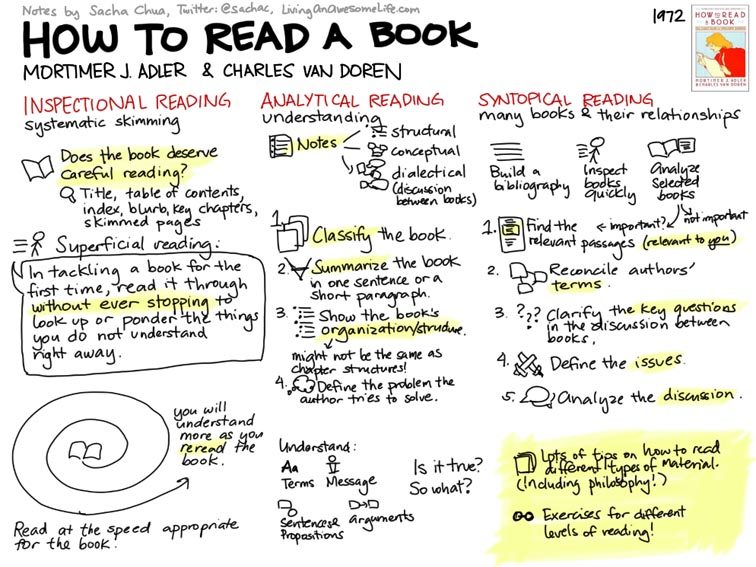
Which is where the following sketch note from livinganawesomelife.com comes in. We first shared this graphic in a post featuring examples of sketchnotes (a note-taking form near and dear to my heart), but this one felt worthy of its own post because it captures the essence of the book in a form teachers can actually use.
3 Strategies & Questions For Critical Reading
For most of us, reading strategies aren’t new, and neither is the idea of reading through a critical lens. What may be new is naming distinct mindsets students (and teachers) can adopt when approaching texts—and pairing those mindsets with purposeful questions.
Inspectional Reading
Reading with a focus on grasping the book as a whole—what Adler and Van Doren call “systematic skimming.”
This level of reading asks the reader to orient themselves: What kind of text is this? What problem is it addressing? How is it organized?
Example question:
Why is this book important or worth reading? How might our answer change before reading, during an initial reading, and then during a second reading?
In classrooms, inspectional reading supports previewing, text selection, and goal-setting—skills that strong readers use automatically but struggling readers often lack.
Analytical Reading
Reading with a focus on close examination and analysis of the text itself.
Here, the reader slows down. Claims are examined, language is scrutinized, and meaning is constructed deliberately.
Example question:
How does Thomas Merton use setting to establish and develop the theme of The Seven Storey Mountain? How would our reading change if it were driven by that question?
This level aligns closely with disciplinary literacy, where students read like historians, scientists, or literary critics rather than generic “readers.”
Syntopical Reading
Reading with a focus on relationships between texts.
This is the most demanding form of reading, requiring readers to synthesize ideas across multiple sources and perspectives.
Example question:
How can Joseph Heller’s Catch-22 be read as a response to Erich Maria Remarque’s All Quiet on the Western Front? If we assume it is a response, how does that assumption change how we read Catch-22?
Syntopical reading underpins inquiry-based learning, research writing, and critical thinking at the highest levels.
If you’ve read How to Read a Book, you’ll recognize that this is an oversimplification of Adler and Van Doren’s framework. But for the purposes of a short, usable classroom post, the core idea holds: reading well is less about techniques and more about intentionality.
That, more than any single strategy, is the heart of critical literacy.
Reference
Pressley, M., & Afflerbach, P. (1995). Verbal protocols of reading: The nature of constructively responsive reading. Lawrence Erlbaum Associates.