
What Are The Pillars Of Digital Leadership In Education? [Updated]
From Digital Citizenship To Digital Leadership
How responsible participation in digital spaces can evolve into leadership that improves schools, culture, and community.
Digital Citizenship has become one of the more symbolic phrases that represent the significant impact technology has made on our behavior and interactions.
What is the definition of digital citizenship? Terry Heick has offered that digital citizenship is “The quality of habits, actions, and consumption patterns that impact the ecology of digital content and communities.” In short, it’s taking care of the ‘things’ we depend on in digital spaces.
This isn’t an easy concept for many students to wrap their head around, as it involves aspects of scale, permanence, and credibility that they are just beginning to wrestle with. Citizenship as an idea of its own is both crucial and crucially misunderstood, often reduced to political notions (Be heard–Vote!) or those ecological (Always Recycle!). Consider how infrequently many adults consider how the work they do, the things they buy, or the food they eat affects national or global citizenship.
This is all big picture thinking that is, somehow, easy to miss.
The Visual
Which brings us to the visual above. Sylvia Duckworth got together with Jennifer Casa-Todd to illustrate an interesting twist on this idea–moving from mere “citizenship” to inspired leadership in digital spaces, using two definitions from George Couros.
Digital Citizenship: Using the internet and social media in a responsible and ethical way
Digital Leadership: Using the internet and social media to improve the lives, well-being, and circumstances of others.
The idea behind the shift? A kind of empathy–moving beyond seeing one’s self, and moving towards seeing one’s self in the physical and digital company of others. As digital technology and social media become more deeply embedded in our lives, and more nuanced in their function, this is a shift whose time has come.
The question becomes, then, what’s the next evolution of this idea?
As schools change, leadership must as well.
With society becoming more and more reliant on technology, it is incumbent upon leaders to harness the power of digital technologies in order to create school cultures that are transparent, relevant, meaningful, engaging, and inspiring. In order to set the stage for increasing achievement and to establish a greater sense of community pride for the work being done in our schools, we must begin to change the way we lead. To do this, leaders must understand the origins of fear and misconceptions that often surround the use of technology such as social media and mobile devices.
Once the fears and misconceptions are placed on the table, leaders can begin to establish a vision for the effective use of technology to improve numerous facets of leadership. The challenge for school leaders is why, how, and where to begin. Digital leadership is not about flashy tools, but a strategic mindset that leverages available resources to improve what we do while anticipating the changes needed to cultivate a school culture focused on engagement and achievement. It is a new construct of leadership that grows out of the leader’s symbiotic relationship with technology.
The end result will be sustainable change in programs, instruction, behaviors, and leadership practices with technology as a pivotal element. Digital leadership requires a shift in leadership style from one of mandates, directives, and buy-in to one grounded in empowerment, support, and embracement as keys to sustainable change.
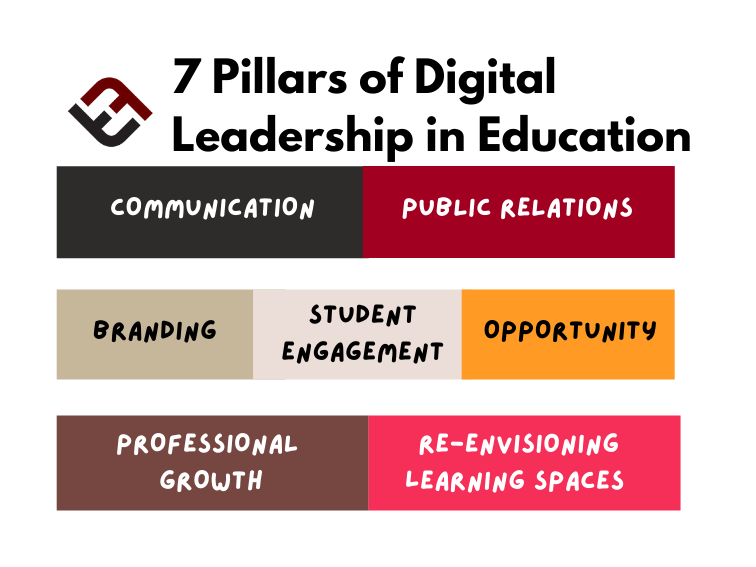
From my work I have identified what I call the Pillars of Digital Leadership. These are the specific areas embedded in the culture of all schools that can be improved or enhanced through the use of available technology, especially social media. They present a framework from which any educator or leader can begin to harness the power of technology to change professional practice and initiate sustainable change.
For schools looking for broader guidance on responsible technology use, the ISTE overview of digital citizenship and the ISTE Standards for Students both help clarify what this work can look like in practice.
At TeachThought, this shift also connects naturally to broader conversations about digital citizenship and the role of technology in education in shaping learning, participation, and culture.
7 Pillars of Digital Leadership In Education
Note: Graphic by New Milford HS student Grace Jeon.
1. Communication
Leaders can now provide stakeholders with relevant information in real-time through a variety of devices. No longer do static, one-way methods such as newsletters and websites suffice. Important information can be communicated through various free social media tools and simple implementation strategies in order to meet stakeholders where they are in the digital age.
2. Public Relations
If we don’t tell our story, someone else will, and more often than not, another’s version will not be the one we want told. Leaders need to become storytellers-in-chief. We can now form the foundation of a positive public relations platform using free social media tools where we control the content. By doing so, we create the means by which we share all of the positives associated with our schools and create a much-needed level of transparency in an age of negative rhetoric toward education.
3. Branding
Businesses have long understood the value of the brand and its impact on current and potential consumers. Leaders can leverage social media tools to create a positive brand presence that emphasizes the positive aspects of school culture, increases community pride, and helps to attract and retain families when looking for a place to send their children to school.
4. Student Engagement/Learning
We cannot expect to see increases in achievement if students are not learning. Students that are not engaged are not likely to be learning. Leaders need to understand that schools should reflect real life and allow students to apply what they have learned through the use of the tools they are using outside of school.
Digital leaders understand that we must put real-world tools in the hands of students and allow them to create artifacts of learning that demonstrate conceptual mastery. This is an important pedagogical shift as it focuses on enhancing essential skill sets—communication, collaboration, creativity, media literacy, global connectedness, critical thinking, and problem-solving—that society demands.
5. Professional Growth/Development
With the rise of social media, schools no longer have to be silos of information and leaders do not have to feel like they are on isolated islands that lack support and feedback. Leaders can form their own Personal Learning Network (PLN) to meet diverse learning needs, acquire resources, access knowledge, receive feedback, connect with both experts in the field of education as well as practitioners, and discuss proven strategies to improve teaching, learning, and leadership.
6. Re-Envisioning Learning Spaces and Environments
Once leaders understand the pillars and how to use them to initiate sustainable change, the next step is to begin to transform learning spaces and environments that support essential skill sets and are aligned with the real world. Leaders must begin to establish a vision and strategic plan to create an entire school building dedicated to learning in an ever more digital world. In order to do so, leaders must be knowledgeable of the characteristics and dynamics that embody innovative learning spaces and environments.
7. Opportunity
It is important for leaders to consistently seek out ways to improve existing programs, resources, and professional development. Digital leaders leverage connections made through technology and increase opportunities to make improvements across multiple areas of school culture.
Conclusion
Leaders need to be the catalysts for change and the pillars identified above provide a framework.
Each is critical in its own right to transforming and sustaining a positive school culture. By addressing each of these pillars, leaders can begin changing and transforming their respective schools into ones that prepare learners with essential digital age skills while engaging a variety of stakeholders. Digital leadership begins with identifying obstacles to change and specific solutions to overcome them in order to transform schools in the digital age.