
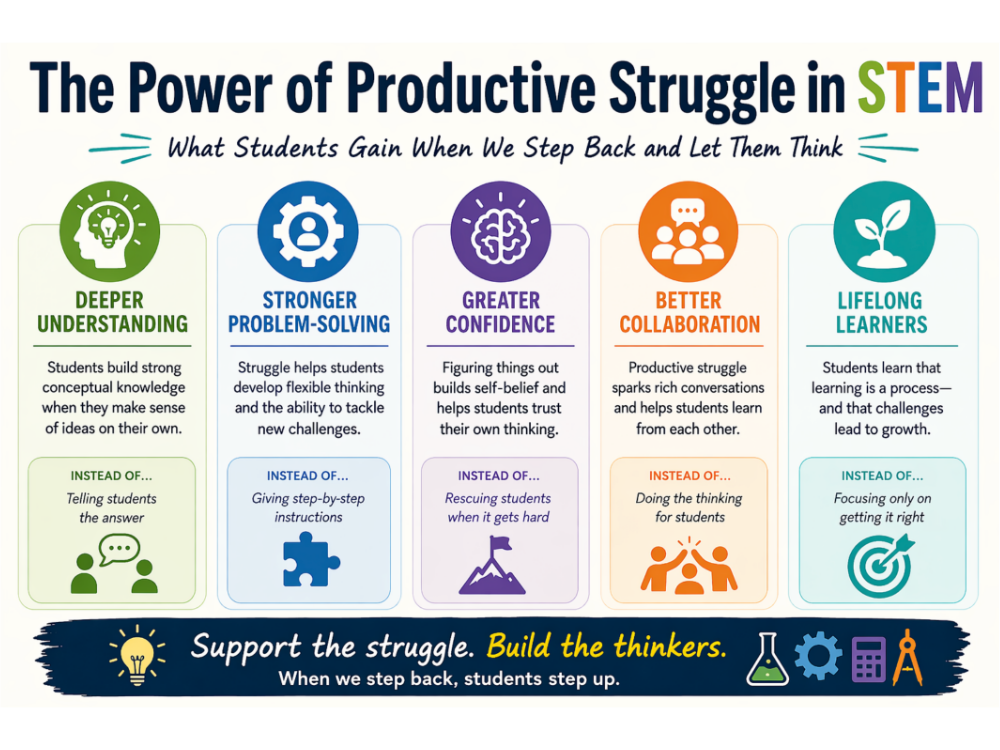
contributed by Christopher Feiler, Ph.D
The lesson looked great on the surface.
Students were on task. Materials were moving. Directions were being followed step by step.
But something felt off.
No one was stuck.
No one was asking questions.
No one was thinking.
That’s the moment you realize: the problem isn’t engagement. The task is too easy.
When STEM Tasks Miss the Mark
Too Easy
- Follow steps.
- No decisions.
- Fast finish.
- “Is this right?”
Just Right
- Makes decisions.
- Productive struggle.
- Tests ideas.
- “What if…?”
Too Hard
- Confused quickly.
- Stuck early.
- Gives up.
- Needs constant help.
Most classrooms don’t land in the middle by accident. When everything is scaffolded, nothing is figured out.
The Real Problem
We’ve been trained to value engagement. If students are busy, we assume learning is happening.
But busy doesn’t mean thinking.
A student can follow directions perfectly and still avoid making a single decision. That’s not learning, that’s compliance.
When everything is scaffolded, nothing is figured out.
Why This Happens
It usually comes from a good place.
- We want students to feel successful.
- We break tasks into clean, manageable steps.
- We give help early to prevent frustration.
- We model the “right way” too soon.
Before long, the lesson runs smoothly. Too smoothly.
Like bowling with bumpers. You can’t miss, but you’re not really playing either.
5 Signs Your Lesson Is Too Easy
If students don’t have to think, they won’t.
1. Students finish quickly with no friction
They move fast. They check boxes. They’re done before you expect it. Speed replaces thinking.
2. Every student produces the same result
Same design. Same answer. Same process.
That’s not creativity. That’s copying work with confidence.
3. Students ask, “Is this right?”
You’ll hear it over and over.
Not “Why does this work?”
Not “What if I tried this?”
Just “Is this right?”
That’s a red flag.
No forks in the road means no thinking at the wheel.
4. There are no real decisions to make
If the steps are numbered 1 through 10, students don’t have to think. They just follow the map.
No forks in the road means no thinking at the wheel.
5. Help shows up too early
A student hesitates. We jump in.
We explain. We guide. We rescue.
We mean well. But we just took the thinking away.
How to Fix It (Without Blowing Up Your Lesson)
You don’t need a full redesign. Small moves change everything.
1. Remove one step
Take out a direction. Just one.
Let students figure out what’s missing. That gap? That’s where thinking lives.
You don’t need a full redesign. Small moves change everything.
2. Add a decision point
Instead of telling them how to build or solve, ask, “How do you want to approach this?”
Now they own part of the process.
3. Wait longer than feels comfortable
A student says, “I don’t get it.”
Pause.
Give it a few seconds.
That silence? That’s not failure. That’s processing.
4. Change your questions
Swap this:
“Is it correct?”
For this:
“Why did you choose that?”
“What would happen if you tried something else?”
Now you’re pulling thinking out instead of pushing answers in.
5. Accept different outcomes
Not every project should look the same.
Not every answer should match.
Variation is a sign of thinking, not confusion.
A Quick Classroom Shift
A group of students was building a simple wind-powered car.
At first, the lesson was tight. Clear steps. Clean directions. Everyone finished.
Fast.
Too fast.
So one change was made. The instructions were cut in half. Students had to decide how to attach the sail and adjust for movement.
The room changed immediately.
Some cars didn’t move.
Some spun in circles.
Some barely worked.
And then the real work started.
Students tested. Adjusted. Argued. Tried again.
Same materials. Same goal.
Completely different thinking.
Can students complete this task without making a decision? If the answer is yes, the task is too easy.
A Simple Way to Think About It
Picture a spectrum:
Too Easy → Just Right → Too Hard
- Too Easy = students follow directions
- Just Right = students make decisions
- Too Hard = students shut down
The goal isn’t to land in the middle by accident.
You design for it.
The Thinking Test
Can students complete this task without making a decision?
If the answer is yes, the task is too easy.
Final Thought
The goal isn’t to make learning harder.
It’s to make thinking unavoidable.
If students can complete your lesson without making decisions, they’re not really learning.
They’re just along for the ride.
And nobody gets better by sitting in the passenger seat.