
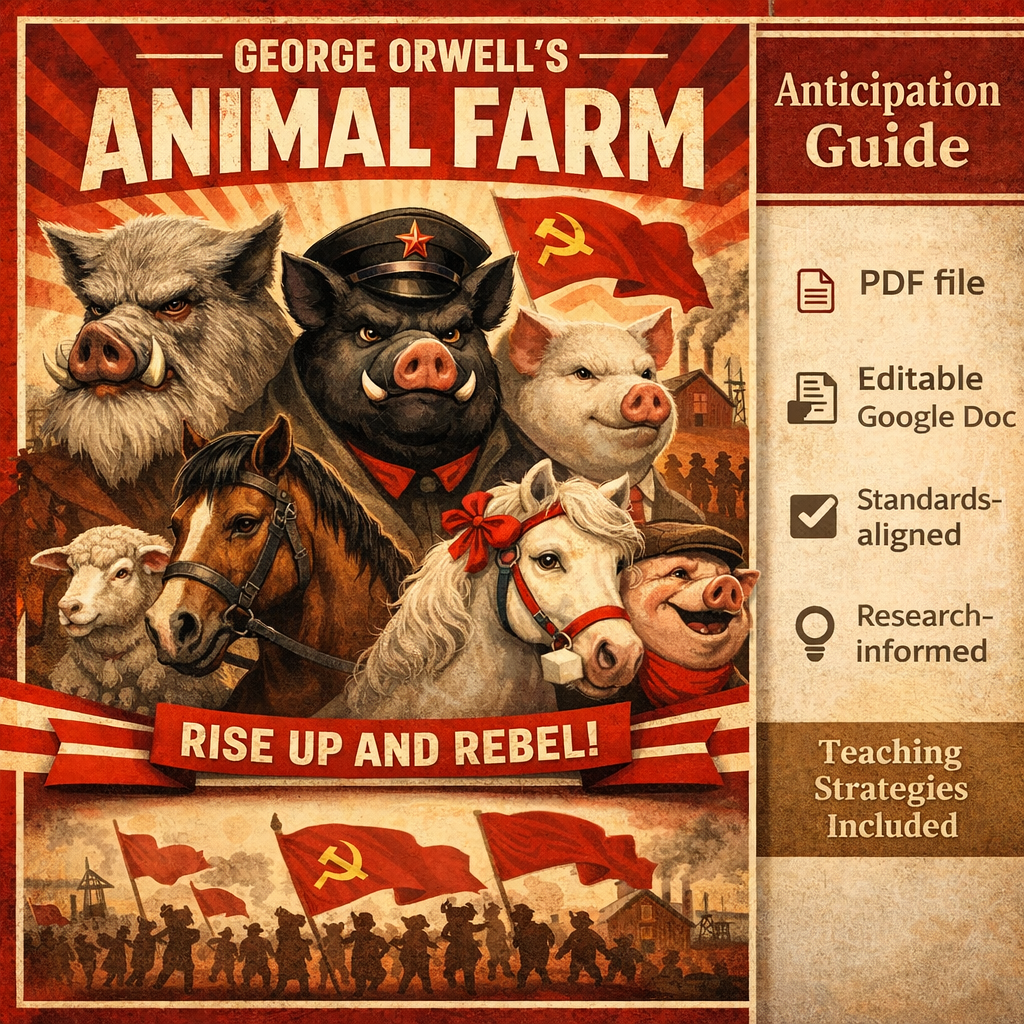
Animal Farm Anticipation Guide (Grades 6–8)
Agree / Disagree Discussion Activity | PDF + Editable Google Doc
This anticipation guide for Animal Farm uses 12 statements to frame student thinking before and during reading.
Students record positions, then return to those responses as the novel unfolds, adjusting or defending their thinking with evidence.
The activity centers on power, loyalty, language, and moral compromise rather than on previewing allegory or historical context.
Because the novel shows how authority shifts gradually and how language can reshape what people accept as true, the guide gives students a clear starting point. Students consider what can happen when a group accepts small changes without questioning where those changes lead. This connects naturally to broader work on critical thinking in the classroom.
What’s Included
- 12 statements with Agree / Disagree / Unsure response format
- 8 instructional strategies organized for use before, during, and after reading
- Story-specific examples tied to major characters and turning points in the novel
- Research support (Duffelmeyer, 1994; Ortlieb, 2013) with brief summaries
- Common Core ELA alignment (Grades 6–8)
- PDF + editable Google Doc
Sample Statements
“Tradition can be dangerous.”
“Belonging to a group requires giving up moral independence.”
“People are more likely to question rules that hurt them than rules that hurt others.”
“Silence is the same as agreement.”
Instructional strategies include short examples connected to key moments in the novel, including the rise of Napoleon, the role of Squealer, Boxer’s loyalty, and the rewriting of the Seven Commandments.
Classroom Uses
- Pre-reading work for Animal Farm
- Discussion-based lessons
- Think-Pair-Share
- Small-group discussion
- Socratic seminar
- Writing and argument practice
- Whole-class discussion
Grades & Use
Designed for grades 6–8 and adaptable for older students depending on instructional context. The guide can be used in a single class period or revisited throughout an Animal Farm unit as students reconsider earlier responses.