
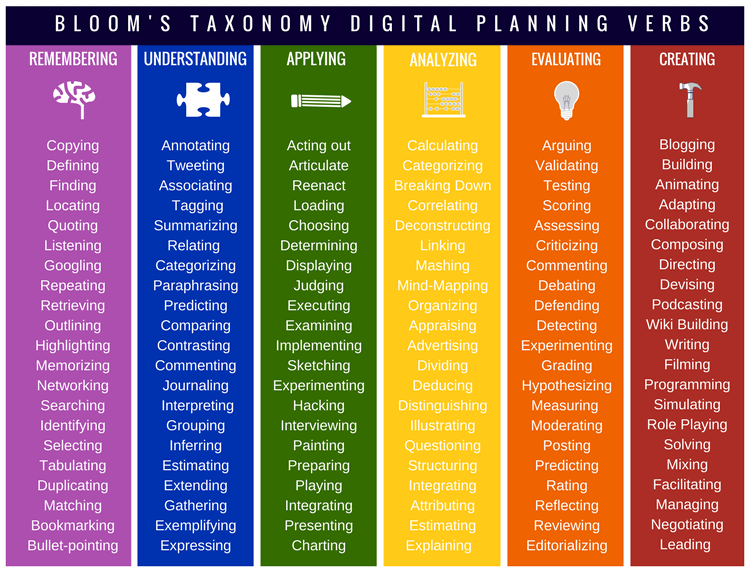
Bloom’s Taxonomy New Edition | Digital Planning Verbs Cards
Posters + Classroom Cards | PDF Resource for Lesson Planning and Critical Thinking
This resource combines Bloom’s Taxonomy with a large set of digital planning verbs teachers can use for lesson planning, assessment design, and the general planning of learning experiences based on thinking and complexity.
The set is designed to make Bloom’s more usable in daily practice by pairing each level of thinking with practical verbs and printable visual supports.
It includes both full-page reference materials and individual classroom cards, making it useful for teacher planning, classroom display, instructional coaching, and small-group work.
Because Bloom’s Taxonomy remains one of the most widely used frameworks for organizing cognitive complexity, these materials offer a practical bridge between theory and classroom application. This connects naturally to broader work on critical thinking in the classroom.
What’s Included
- 249 Bloom’s Taxonomy verbs for critical thinking
- 1 printable PDF of Bloom’s Taxonomy
- 1 printable PDF of Bloom’s Taxonomy Digital Planning Verbs
- 1 set of classroom cards with Bloom’s digital planning verbs
- 6 alternatives to Bloom’s Taxonomy for teachers
- Printable PDF format
Bloom’s Levels Included
- Remembering
- Understanding
- Applying
- Analyzing
- Evaluating
- Creating
Sample Verbs
Remembering: copying, defining, finding, locating, quoting
Understanding: annotating, summarizing, comparing, interpreting, inferring
Applying: acting out, choosing, implementing, experimenting, presenting
Analyzing: categorizing, deconstructing, linking, questioning, structuring
Evaluating: arguing, validating, testing, rating, reviewing
Creating: building, composing, directing, podcasting, programming, writing
Classroom Uses
- Lesson planning
- Assessment design
- Question stems and discussion prompts
- Classroom display
- Instructional coaching
- Professional learning and planning sessions
Grades & Use
Designed for flexible use across grade levels and subject areas. The resource can be used by classroom teachers, instructional coaches, and curriculum teams as a planning reference, instructional support, or visual framework for classroom thinking.