
SEL Journal Prompts Middle School | 50 Metacognitive Writing Prompts | CASEL
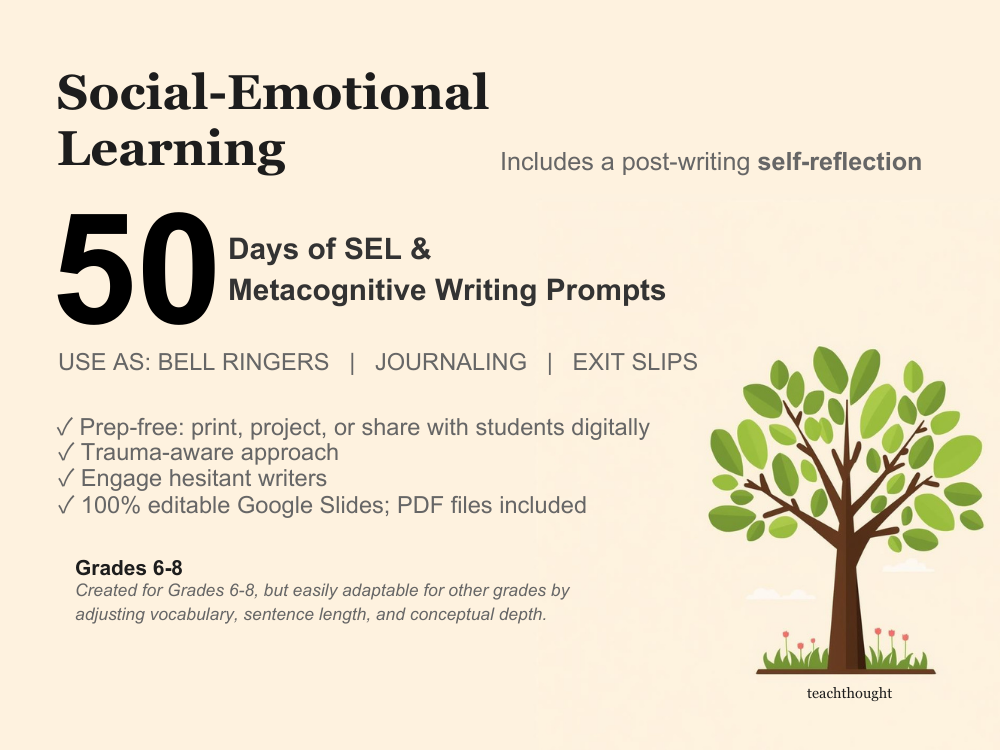
Summary: 50 SEL journal prompts for middle school (grades 6–8) with a built-in, student-friendly self-reflection rubric. This curriculum covers six SEL domains aligned to CASEL competencies. Includes Google Slides and a print-ready PDF. You can find a sample of the prompts below.
Description
This resource includes 50 reflective writing prompts designed to help middle school students develop social-emotional skills through structured journaling. Each prompt encourages students to explore their thoughts and emotions without pressure to arrive at a neat conclusion. A dedicated category—Reflection Without Resolution—is included for prompts that support noticing, processing, and sitting with complexity.
Prompts are written to be accessible, age-appropriate, and flexible for a range of classroom contexts, including advisory, morning meetings, and weekly journaling routines.
Trauma-Aware Approach
Trauma is more common in classrooms than is often visible. It can emerge from single events or ongoing circumstances that exceed a student’s ability to process, integrate, and self-regulate. These experiences may affect emotional regulation, participation, self-concept, and relationships at school.
This resource is designed with trauma-aware teaching in mind. While some prompts may be appropriate for small-group sharing, others—and some students—may benefit from keeping their writing private. Prompts are intentionally written to avoid requiring disclosure, but teachers are encouraged to use professional judgment when deciding if, how, or whether sharing should occur.
SEL Writing Journal Response Examples
1. Reflection Without Resolution
Slow Reveal
Write about a choice that seemed fine at first but later did not work out as expected. When did you begin to notice something was off? What changed in how you understood the situation?
Staying Open
Choose an issue or question that remains unfinished in your mind. What keeps it open, and what does it feel like to sit with something unresolved?
2. Social Navigation
Different Settings
Notice how you behave differently in two settings (for example, school and home). What changed, and what about each environment influenced you?
The Boundary
Describe a time you encountered a boundary—one you set, one someone else set, or one you crossed. How did you become aware of it, and what did you learn?
3. Self-Awareness
Catching Yourself
Describe a moment when you recognized yourself losing focus or composure. What helped you notice it, and what did you do next?
Inner Debate
Write about an internal conflict you’ve experienced. What were the competing perspectives, and what did each one seem to value or fear?
4. Embodied Awareness
Body First
Think of a moment when your body reacted before you had time to think. What physical signals showed up first? What was happening around you?
Pushing Through
Describe a time you ignored physical signals like tiredness or tension and kept going. What helped you continue, and what might your body have been signaling?
5. Decision-Making
The Hover
Write about a time you were stuck between two choices. What made the decision difficult, and what helped you move forward?
Energy Budget
Describe a time you decided how much effort or time to invest in something. What guided that decision?
What’s Included
• 50 SEL writing prompts for grades 6–8
• Post-writing self-reflection rubric (student-facing and non-evaluative)
• Editable Google Slides
• Print-ready PDF
• Implementation guide with pacing suggestions
• CASEL alignment reference
• Free future updates to this prompt set
Six SEL Domains Covered
• Social Navigation – relationships, peer dynamics, communication
• Self-Awareness – identifying emotions, recognizing patterns, personal strengths
• Self-Regulation – managing stress, coping strategies, emotional responses
• Embodied Awareness – mind-body connection, physical signals, grounding
• Decision-Making – weighing options, considering consequences
• Reflection Without Resolution – processing complexity without pressure
How Teachers Use This Resource
Teachers often project one prompt at the start of advisory or class. Students write for 5–6 minutes, adjusting time based on engagement and comfort with the prompt.
At the end of the week, students use the self-reflection rubric to look back across entries, supporting goal-setting, portfolio work, or ongoing journaling routines. The rubric is designed for reflection rather than grading.