
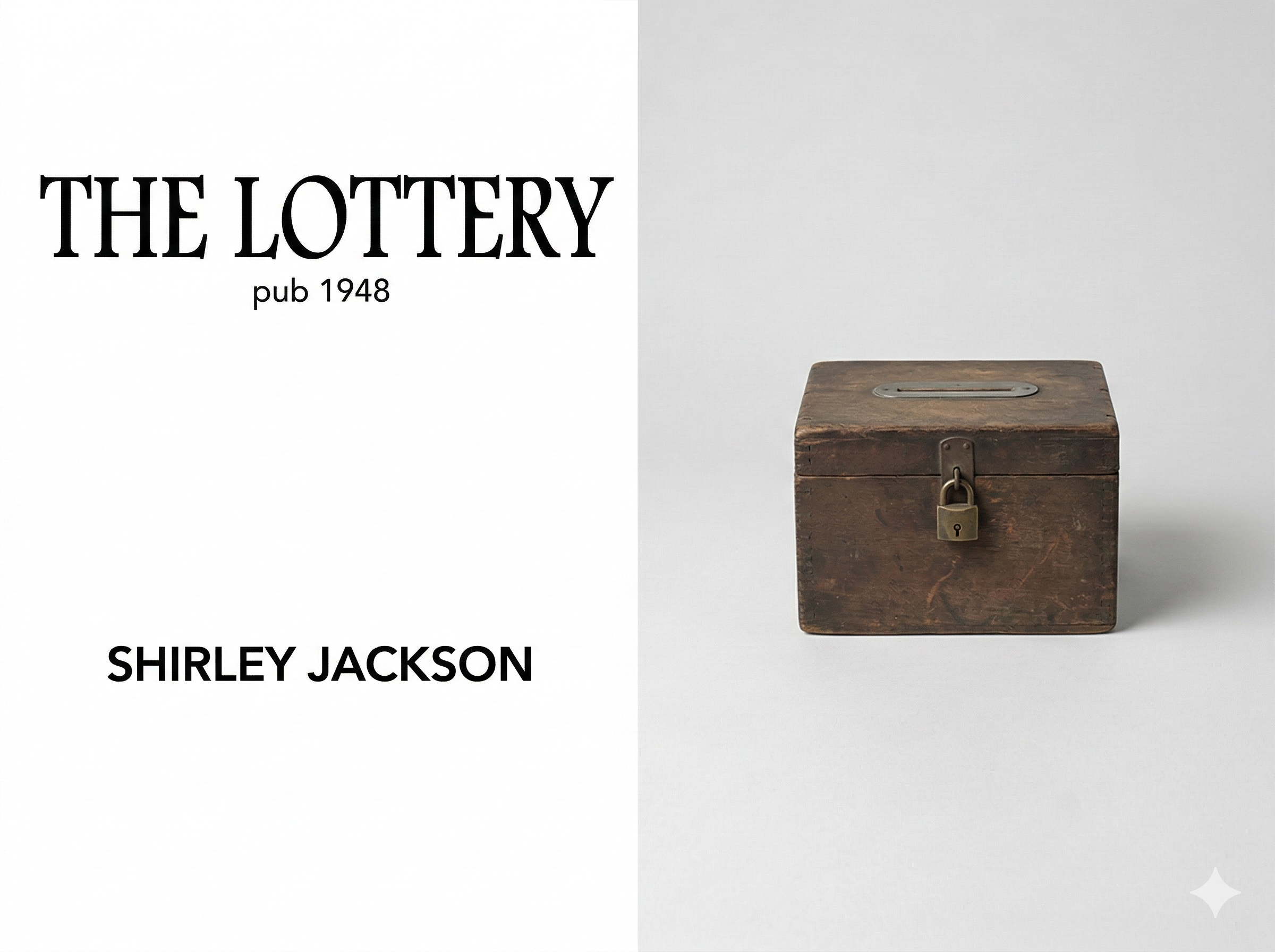
The Lottery Anticipation Guide | Agree/Disagree Discussion Activity | Grades 8–10
Literary Discussion Resource | Print-Ready PDF + Editable Google Doc
This resource includes a 12-statement anticipation guide for Shirley Jackson’s “The Lottery”, with a teacher section covering implementation strategies and research context.
The statements are designed to surface beliefs students will revisit as they read. The goal is not to preview plot or theme, but to create positions students may later defend, refine, or abandon based on evidence from the text.
For a story where the ending reframes everything that came before it, this structure has a specific payoff: students do not just encounter the twist; they can trace how their own assumptions made it possible.
Get the complete The Lottery anticipation guide.
Purchase ResourceWhat’s Included
Agree / Disagree / Unsure response format.
Story-specific examples organized by when to use them: before reading, during reading, and after reading.
Includes two citations with plain-language summaries: Duffelmeyer, 1994; Ortlieb, 2013.
Common Core ELA alignment for Grades 8–10.
Print-ready PDF and editable Google Doc.
Sample Statements
“Tradition can be dangerous.”
“Belonging to a group requires giving up moral independence.”
“People are more likely to question rules that hurt them than rules that hurt others.”
“Silence is the same as agreement.”
Example Teaching Strategies
The teacher section includes brief, story-specific guidance for using the guide before, during, and after reading.
Each strategy includes a brief example specific to “The Lottery,” showing how it connects to the guide’s statements through Tessie Hutchinson, Old Man Warner, and the lottery ritual.
Research Basis
Duffelmeyer (1994) found anticipation guides most effective when statements target existing beliefs the text will directly challenge.
Ortlieb (2013) found students using anticipatory guides outperformed control groups on comprehension measures. Both sources are cited in full with plain-language summaries in the teacher section.
Grades & Use
Designed for Grades 8–10. The guide can be used in a single class period or distributed across a full unit.
With modification to language and conceptual complexity, it is also likely usable in 7th-grade and 11th-grade classrooms. It works for think-pair-share, Socratic seminar, small group discussion, or whole-class discussion.
Use The Lottery to help students test their assumptions against the text.
Purchase Resource