Teachers at school and college now have to check student work more carefully as students increasingly rely on AI for essays and assignments. At the same time, the detector needs to distinguish AI-generated content from genuine student writing without incorrectly flagging it. That’s why we put together a list of the best tools to detect AI-generated text and tested how well they handle different types of academic writing.
Quick Guide: Best and Most Accurate AI Detector Tools
If you need to check if AI generated text appears in student work, these five tools are good options for different classroom needs.
- Clever AI Detector: Best free AI checker for teachers and the most balanced option overall.
- Copyleaks: Strong for humanized AI content.
- Originality.ai: Strong for AI-edited human writing.
- Winston AI: Useful for bulk document checks.
- QuillBot AI Detector: Simple option for quick checks.
Best AI Detector for Academic Writing
Below is our list of the best AI detector for writing options. We reviewed each app to detect AI writing, covering its functionality and how it performed across different types of text in our tests.
1. Clever AI Detector
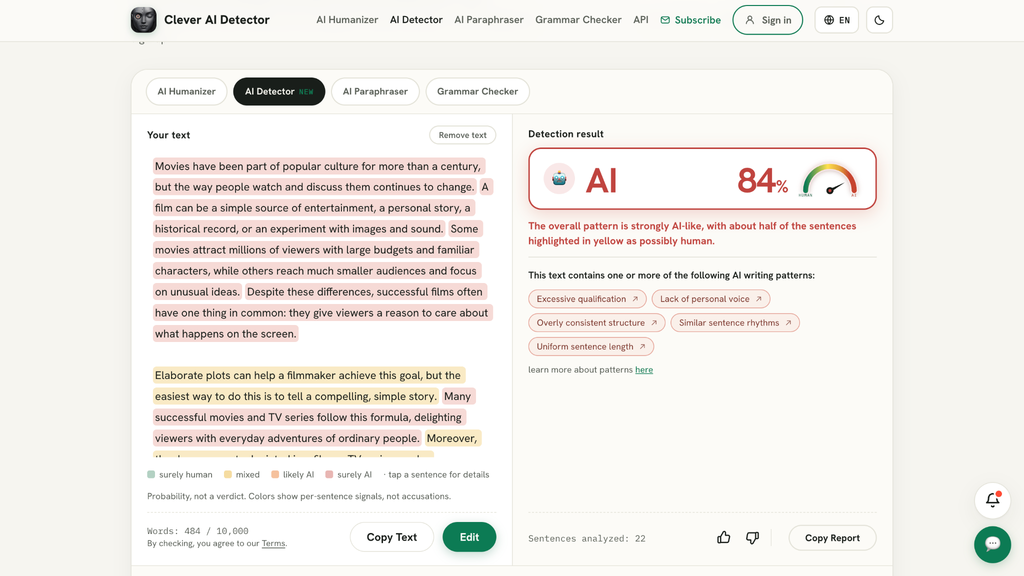
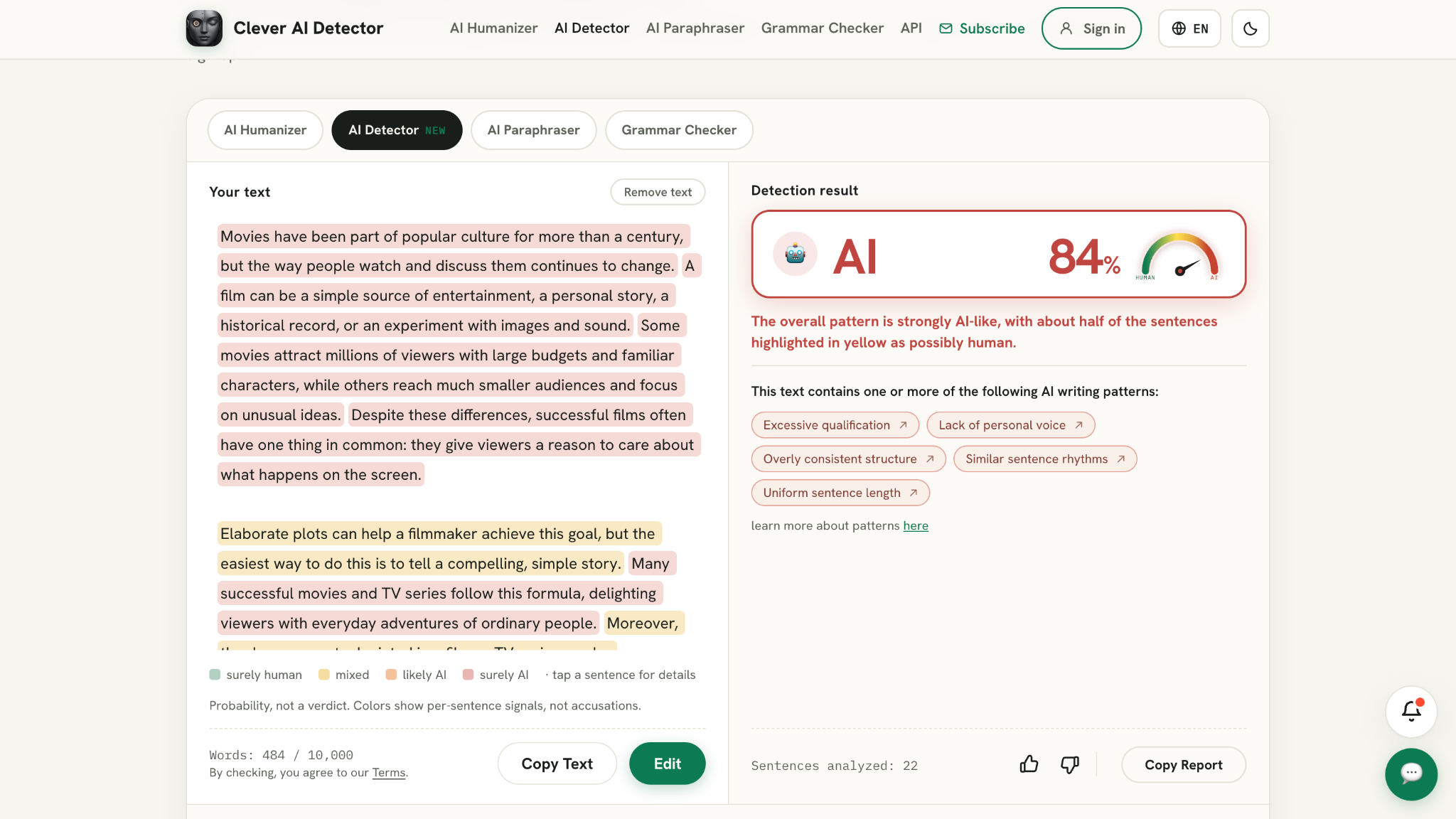
Clever AI Detector is the best AI detection for teachers and the most balanced option overall. It checks up to 10,000 words per scan with unlimited checks and provides an overall AI score plus sentence-level results: Surely Human, Mixed, Likely AI, and Surely AI. It also explains specific AI writing patterns, such as lack of personal voice, overly polished language, excessive transition words, and more. You can paste text directly or upload a document for analysis. No registration is required to access the full detector functionality, but creating a free account gives you access to Scan History, where you can return to your previous checks. Within the platform, you get AI detection and humanizer tools, and you can also paraphrase essay text – all for free.
Strongest point: Clever AI Detector achieved 97.3% overall accuracy. It correctly detected 100% of fully AI-generated and AI-rewritten essays, 94.7% of human-written essays improved with AI, and 92% of humanized AI texts. It also correctly recognized 100% of human-written essays without false positives.
Weakest point: Its results are probability-based, so individual flagged sentences still need to be reviewed in context.
Price: Completely free.
2. Copyleaks
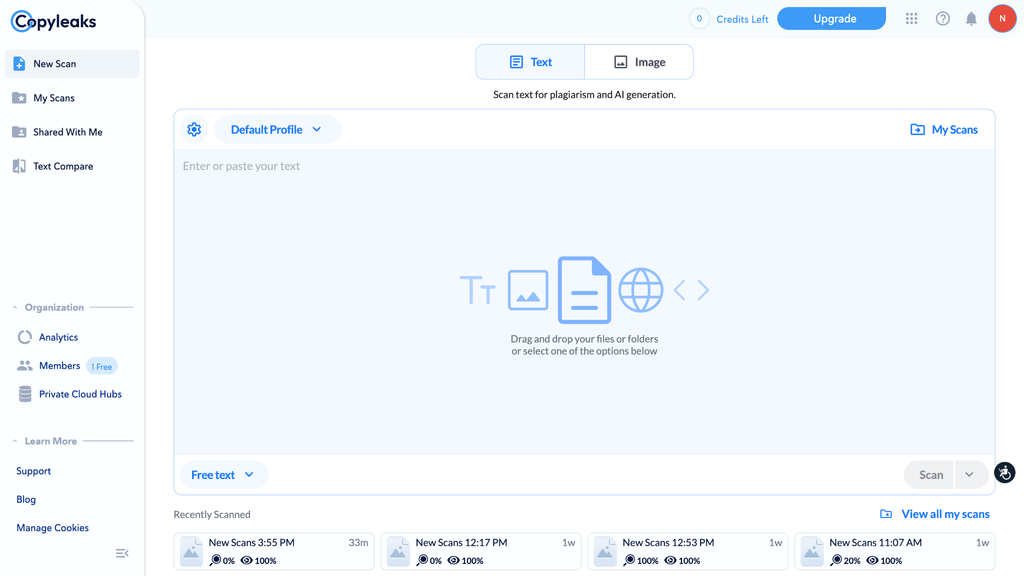
Copyleaks provides an overall AI score and a color-coded report that separates AI-generated and human-written passages. Its AI Phrases feature identifies phrases commonly associated with AI writing, while AI Source Match can find matching AI-generated content. It includes a plagiarism checker, Chrome extension, Google Docs integration, and Scan History to access previous checks. You need to create an account to use the detector, and after registration, you get 5 free scan credits.
Strongest point: Copyleaks showed consistently strong results across different types of AI content and handled humanized writing particularly well, achieving 96% overall accuracy. It correctly detected 100% of fully AI-generated and AI-rewritten essays and 93.3% of humanized AI texts. It also correctly recognized all human-written essays without false positives.
Weakest point: It was less consistent when AI was used to edit or improve an originally human-written draft, correctly detecting 86.7% of such texts. So this type of mixed authorship can be more difficult to identify.
Price: Plans range from $16.99 to $99.99 per month.
3. Originality.ai
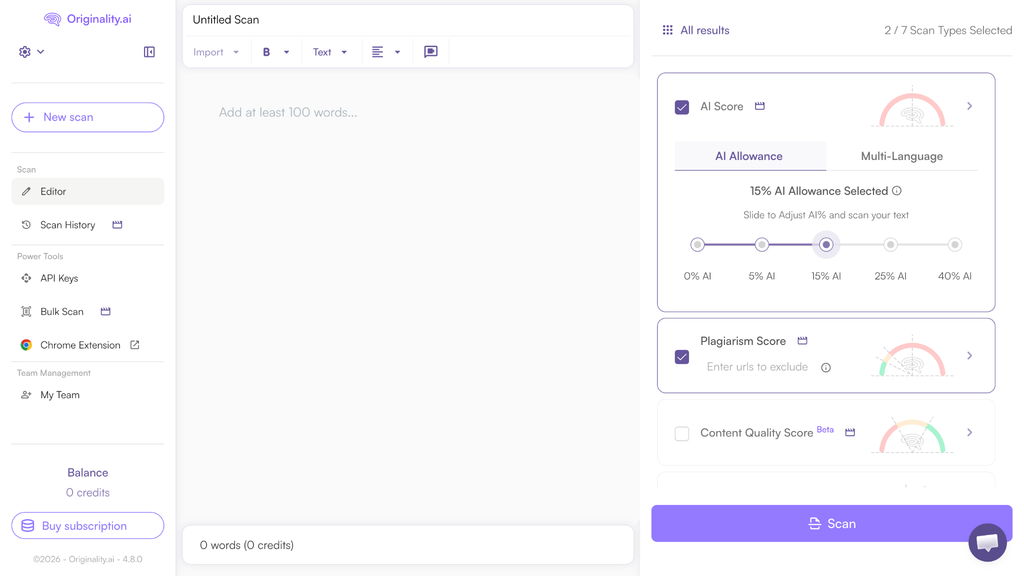
Originality.ai provides an overall AI score with sentence-level highlighting. You can use it without registration, with up to 2,000 words per check and three free scans per day. It highlights suspicious sentences using a color gradient to show how strongly individual sentences appear AI-generated, but does not specify the exact AI writing patterns behind each flag. You can also adjust the AI Allowance to set an acceptable level of AI content. The platform includes plagiarism checking, Scan History, a Chrome extension, and Bulk Scan for checking multiple texts at once.
Strongest point: Originality.ai showed 89.5% overall accuracy. It performed very well with direct AI-generated and AI-rewritten writing, achieving a 100% detection rate in both categories. It also correctly detected 96% of human-written essays improved with AI and recognized 100% of human-written essays without false positives.
Weakest point: Its results were much less reliable with humanized AI content, detecting only 51.3% of such texts. Shorter texts were also more difficult for the detector to classify consistently.
Price: Plans range from $14.95 to $179 per month.
4. Winston AI
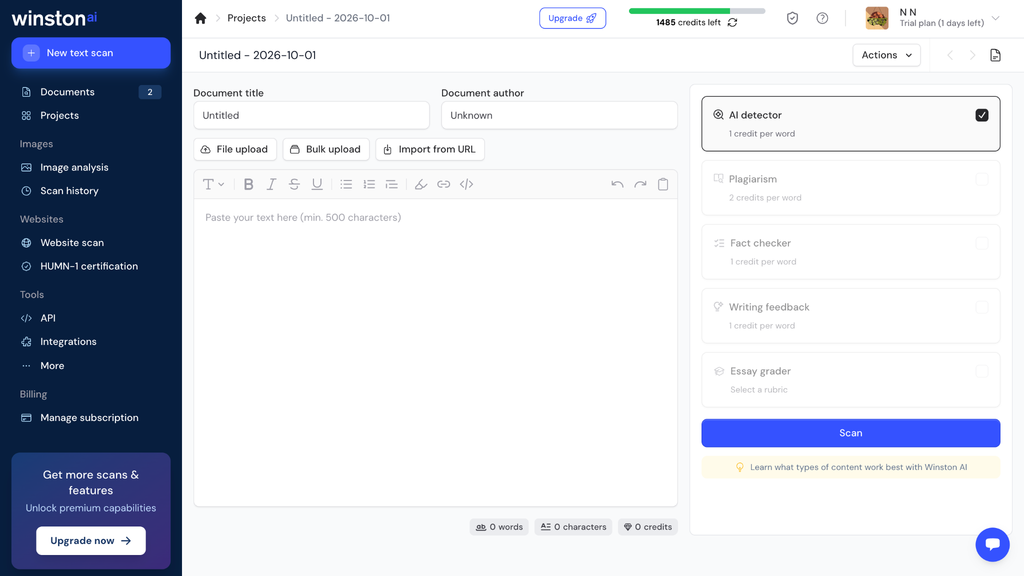
Winston AI provides an overall score and classifies individual sentences as Likely AI, Uncertain, Mostly Human, or Human. Registration is required before you can run a scan, and the free trial includes 2,000 credits in total. The platform supports file upload. It saves previous checks in Scan History and has Bulk Scan for checking multiple documents at once. It also includes a plagiarism checker and fact checker, plus integrations with Chrome, Firefox, Microsoft Edge, Google Classroom, WordPress, Zapier, and more.
Strongest point: Winston AI achieved 86.1% overall accuracy. It worked well with directly generated and AI-rewritten content, correctly identifying 100% of texts in each category. It also detected 86% of human-written essays improved with AI and correctly recognized 100% of human-written essays without false positives.
Weakest point: Humanized AI writing was considerably harder for it to detect, with only 44.7% of such texts correctly identified. Its results also became less consistent with very short and longer text samples.
Price: Plans range from $18 to $49 per month.
5. QuillBot AI Detector
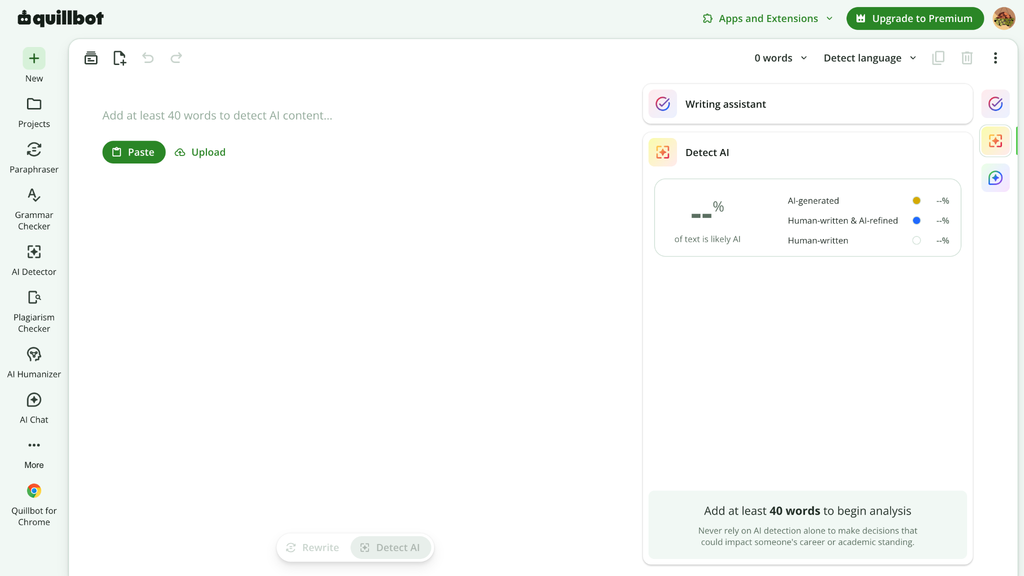
QuillBot provides an overall AI percentage and separates results into categories such as AI-generated, Human-written & AI-refined, and Human-written. You can scan up to 1,200 words for free, but you need to create an account to use the detector. It supports uploading files. The platform includes a plagiarism checker, paraphraser, and AI humanizer. Your previous checks are saved in History, and QuillBot also offers a Chrome extension.
Strongest point: QuillBot achieved 71.3% overall accuracy. It had good results with direct AI-generated and AI-rewritten writing, correctly detecting 100% and 96.7% of texts in these categories, respectively, making it useful for identifying relatively straightforward AI use. It also correctly recognized 100% of human-written essays without false positives.
Weakest point: It had much more difficulty with humanized AI content, detecting only 22% of such texts, and human-written essays improved with AI, detecting 38%. Texts under 200 words were particularly challenging for it to identify reliably.
Price: Plans start at $19.95 per month.
How Should Teachers Interpret AI Detection Results?
Even the best AI content detection tool should not be treated as definitive proof that a student used AI to write an essay or complete home work. AI detector results should serve as supporting evidence, and teachers should consider the context before drawing conclusions:
- Look beyond the overall score. When you check for AI, review sentence-level results and the specific patterns that triggered the detector instead of relying only on the final AI percentage.
- Be careful with short texts. AI detectors generally have fewer patterns to analyze in short samples, which can make their results less reliable.
- Consider the type of AI use. A detector that catches fully AI-generated essays may perform very differently on humanized, paraphrased, or AI-edited human writing.
- Watch for false positives in academic writing. Formal vocabulary, predictable sentence structures, standardized terminology, and highly polished grammar can resemble patterns associated with AI writing.
- Use other evidence. Drafts, document version history, previous writing samples, and a discussion with the student can provide context that an AI score cannot.
- Never treat an AI score as a verdict. Even a high probability should be a reason to review the work more closely, not automatic proof of misconduct.
Final Thoughts
Among the AI checker tools to detect AI generated text we tested, Clever AI Detector stood out as the most balanced option for teachers. It is also one of the best free AI content detector tools, with unlimited checks, detailed sentence-level analysis, and explanations of the AI writing patterns it detects. Still, any AI detector can make mistakes, so teachers should always review the results in context rather than rely on the AI score alone.
Frequently Asked Questions
What is the best AI text detection tool for teachers?
In our tests, Clever AI Detector is best most accurate AI detector that accurately identifies different types of AI writing while keeping false positives on human-written work low.
Can AI detectors tell for sure if a student used AI?
No. AI detectors estimate the likelihood that text was AI-generated based on writing patterns. Their results should support further review rather than serve as definitive proof of AI use.
Can AI detectors identify humanized AI text?
Some can, but humanized content is generally more difficult to detect than direct AI output. Our tests also showed noticeable differences between tools when we checked humanized samples.
Why do different AI detectors give different results?
AI detectors use different models, training data, and methods to classify text. As a result, the same essay can receive different AI scores depending on the tool used.