One-To-One Classroom
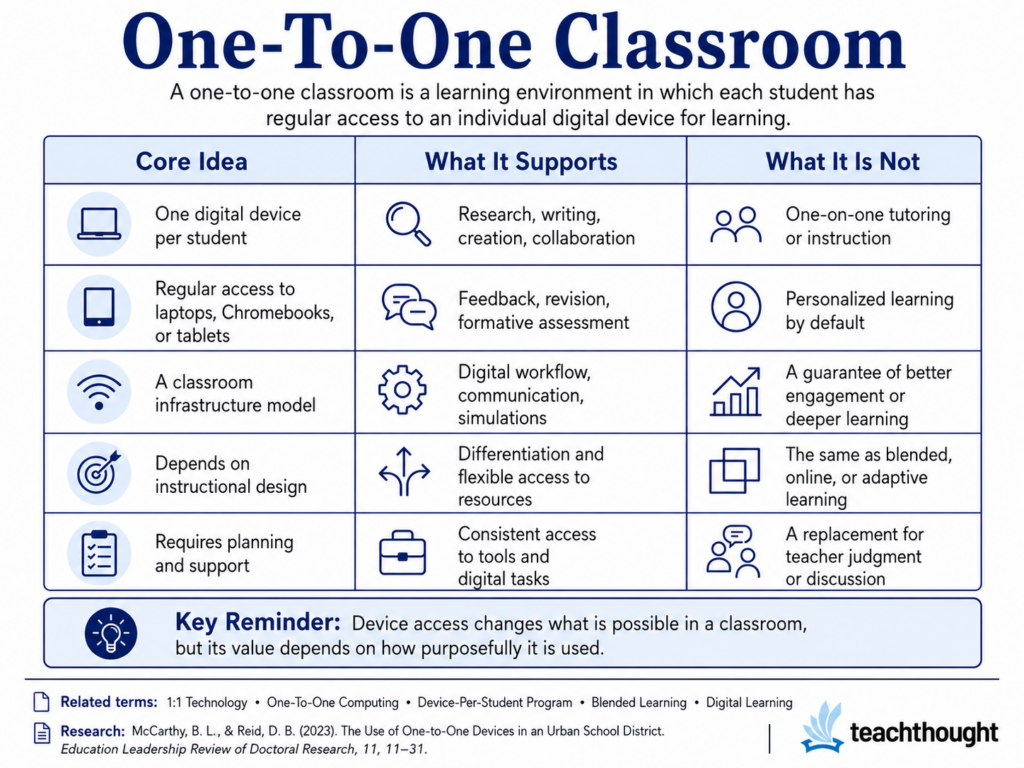
Related Terms: 1:1 Technology · One-To-One Computing · Device-Per-Student Program · Blended Learning · Digital Learning
Overview: A one-to-one classroom is a classroom in which each student has regular access to an individual digital device, such as a laptop, Chromebook, or tablet, for learning.
Why this matters: One-to-one access changes what is technically possible in a classroom, but it does not determine the quality of instruction. Its value depends on how deliberately devices are integrated into learning goals, classroom routines, feedback, collaboration, assessment, and student creation.
Definition: A one-to-one classroom is a learning environment in which one digital device is available for each student. The device may be school-issued, assigned for the school year, provided through a bring-your-own-device policy, or otherwise available whenever instruction requires it.
One-to-one computing may support research, writing, media creation, simulations, formative assessment, communication, collaboration, practice, differentiation, and feedback. It is not synonymous with personalized learning, blended learning, online learning, or one-on-one instruction. For related context, see TeachThought’s discussion of the 1-to-1 learning classroom and its explanation of blended learning .
| Term | Meaning | Relationship To 1:1 |
|---|---|---|
| One-To-One Computing | One digital device per student. | The standard meaning of a one-to-one classroom. |
| Blended Learning | A deliberate combination of face-to-face and digital learning experiences. | May use 1:1 devices, but does not require them. |
| Personalized Learning | Learning adapted to differences in readiness, pace, pathway, interest, or support. | Devices may support personalization, but access alone does not create it. |
| One-On-One Instruction | One educator or tutor working directly with one learner. | A separate instructional ratio, not the standard meaning of a 1:1 classroom. |
Short Examples:
- A middle school assigns each student a Chromebook for research, drafting, revision, and submission.
- A biology class uses individual devices for simulations, lab-data collection, formative checks, and collaborative analysis.
- An elementary class uses tablets selectively for reading fluency practice, documentation, and teacher feedback.
- A high school uses 1:1 laptops, but teachers vary device use according to the learning goal rather than using them continuously.
| A One-To-One Classroom Is | A One-To-One Classroom Is Not Automatically |
|---|---|
| A classroom with one available digital device per student. | A personalized-learning environment. |
| A model that can expand access to digital tools and resources. | Evidence that students are more engaged or learning more deeply. |
| An infrastructure for digital workflow, feedback, research, and creation. | The same thing as blended, online, or adaptive learning. |
| A program that requires instructional planning, routines, support, and maintenance. | A replacement for discussion, direct instruction, teacher judgment, or human feedback. |
Teacher Check: Before Using Devices, Ask
- What learning purpose does the device serve in this lesson?
- What can students do with the device that would otherwise be difficult or impossible?
- When should screens be open, closed, or put away?
- How will student thinking, progress, or understanding become visible?
- What technical, accessibility, or home-access barriers need a backup plan?
Limitations & Challenges:
- Device access alone does not improve instruction or guarantee stronger learning outcomes.
- Distraction may increase when purposes, routines, and monitoring are weak.
- Equity problems can persist through unequal internet access, technical support, accessibility, or home learning conditions.
- Effective implementation requires teacher planning, professional learning, technical support, maintenance, and replacement funding.
- Continuous screen use may displace discussion, handwriting, physical materials, and other valuable forms of learning.
Research Context: In a 2023 study of teachers in an urban school district, McCarthy and Reid described one-to-one computing as a model in which each student has access to an individual device. Teachers generally reported positive views of classroom technology, while also emphasizing that successful implementation depends on time, practice, professional learning, and ongoing support. Because the study examined one school district, its findings should not be assumed to represent every school or implementation context.
Research Citation: McCarthy, B. L., & Reid, D. B. (2023). The Use of One-to-One Devices in an Urban School District . Education Leadership Review of Doctoral Research, 11, 11–31.
Additional Sources: International Society for Technology in Education. (2015). You’ve Gone 1:1. Now What? · K20 Center for Educational and Community Renewal, University of Oklahoma. (2018). One-to-One Technology Initiatives in K–12 Education .