
15 Activities To Help Students Review And Retain New Information
by Terry Heick
Reflection is a natural part of learning.
Students think back on new experiences, review mistakes, reconsider decisions, and make sense of what changed in their understanding. In the classroom, reflection gives students a way to pause, retrieve what they have learned, notice what remains unclear, and prepare to use new information again.
Below are 15 strategies students can use to reflect on learning. Modeling each strategy before students use it independently can improve the quality of responses and make reflection more useful across the year.
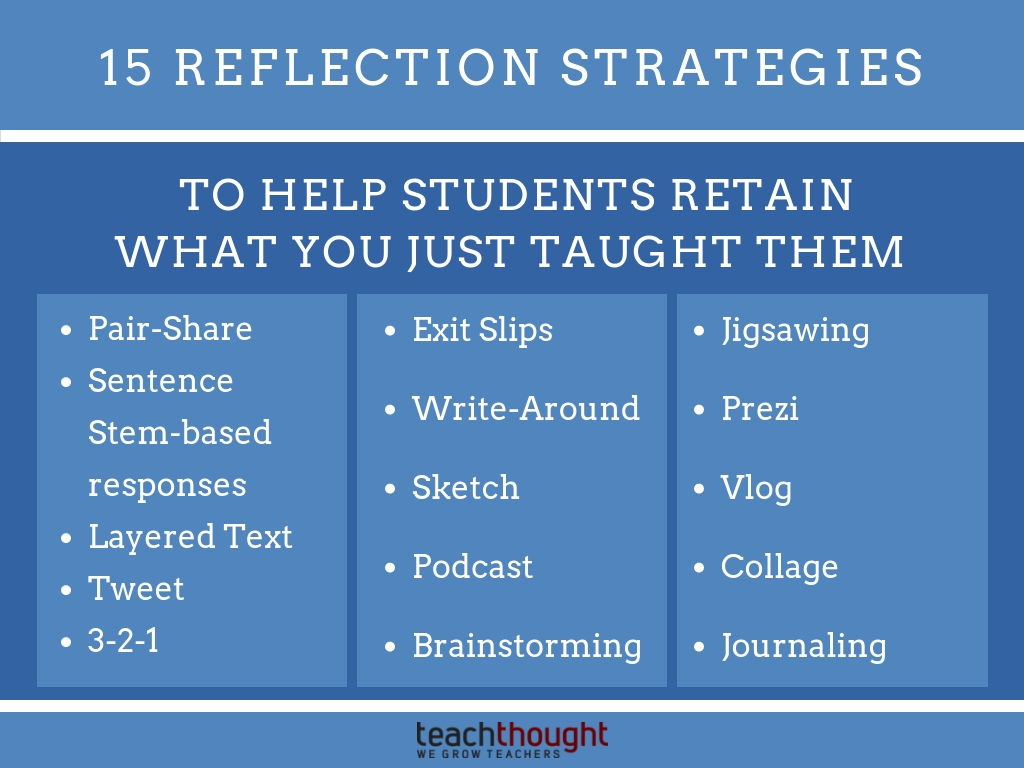
15 Reflection Strategies To Help Students Retain What You Just Taught Them
1. Pair-Share
Pair-share is a classic learning strategy where students are paired and then verbally share something that helps them review new content, deepen understanding, or clarify what they already know.
It can also be used as a quick assessment tool because the conversations often reveal the level of understanding a teacher can use to gauge mastery and plan further instruction.
2. Sentence Stem-Based Responses
Sentence stems can function like training wheels for thinking and speaking. They help students use the language of reasoning before that language becomes natural.
For example, students may be asked to “think critically,” but if they do not have basic phrasing for critical thinking, such as “This is important because…,” the thinking itself may remain out of reach.
Sentence stems can support analysis, comparison, inference, and evidence-based explanation. They are especially useful when students are learning how to move from simple answers to more developed responses.
3. Layered Text
A layered text is a digital document filled with hyperlinks, notes, questions, comments, references, or related resources. These layers can show what students noticed, where they became confused, what they connected to prior knowledge, or what they want to investigate further.
By adding layers of meaning to a text, students can reflect on anything from a pre-assessment journal entry to a later explanation of what they learned, when they learned it, and what helped that learning happen.
4. Text Message Summary
A short text-style response forces students to reflect quickly and directly. This can work well for brief moments of retrieval practice or for hesitant writers who may struggle with a full journal entry.
The limited length can help students identify the most important point, question, misconception, or connection from the lesson.
5. 3-2-1
The 3-2-1 strategy is a familiar way to frame reflection before, during, or after learning.
Students might write:
3 things they think they know
2 things they know they do not know
1 thing they are certain about
After an assessment, they might list:
3 ways their work showed mastery of a skill
2 areas that still need improvement
1 revision they could make immediately
The structure is simple, but it gives students a practical way to separate confidence, uncertainty, and next steps.
6. Exit Slips
Whether they are called exit slips or exit tickets, these brief responses ask students to leave behind evidence of learning before class ends.
That evidence might be a question, definition, misconception, connection, or short explanation. Exit slips are especially useful because they give teachers immediate information about what students understood and what may need to be retaught.
Possible prompts include:
How did your understanding of _____ change today?
What still confuses you about _____?
What question do you have now that you did not have before?
What part of today’s learning felt most difficult?
What is one idea from today that you could explain to someone else?
7. Write-Around
A write-around allows students to write collaboratively and asynchronously. Students respond to a prompt, then read the responses of classmates before adding another response of their own.
The writing does not have to be polished prose. Key vocabulary, short explanations, questions, and sentence fragments can all help students reflect. The value of a write-around is that students can learn from one another while building a shared record of thinking.
When reflection later becomes part of a formal presentation, students may need support organizing their ideas into a slide-based format. In that case, a student might choose to hire powerpoint presentation writer at EduBirdie, while the reflection, evidence, and final explanation should still come from the student’s own learning.
8. Sketch
Sketches, sketchnotes, diagrams, and doodles can help students show what they think they know. They can also show how their understanding has changed.
This strategy works well for students who prefer visual expression. It can also lower the barrier for students who struggle to begin writing. A sketch can give teachers useful evidence of understanding, especially when students are asked to add labels or a short explanation.
9. Podcast
Podcasting can be used as a reflection strategy by having students talk through their learning while recording audio.
The recording does not need to be published publicly. It can remain private, shared only with the teacher, or included in a digital portfolio. The key is that students explain what they learned, what changed in their thinking, and what questions remain.
A shorter version of this strategy is a simple audio reflection. Students can record a one- or two-minute response and submit it as evidence of learning.
10. Brainstorming
Brainstorming can be an effective reflection strategy because it removes some of the barriers found in longer writing tasks.
Students can take a set amount of time to write everything they remember about a topic. They can also brainstorm questions they still have or identify connections between the new material and what they already know.
A concept map can make this strategy more visible. Students can place the main idea in the center, then build connections that show relationships among facts, questions, examples, and misconceptions.
11. Jigsawing
Jigsawing is a grouping strategy where a larger task, concept, text, or problem is broken into smaller pieces. Student groups analyze one piece, then share their findings so the class can reconstruct the larger whole.
As a reflection strategy, jigsawing can help students identify what they understand and what they still need from others. Groups might gather questions, compare explanations, or identify one point of confusion they could not resolve.
Those unresolved questions can then be shared with the class anonymously so the focus remains on the thinking rather than the student who asked the question.
12. Prezi Or Slide-Based Reflection
A slide-based reflection can function as a cross between a sketch, collage, and presentation. Tools such as Prezi, Google Slides, PowerPoint, or Canva allow students to create a visual artifact of learning.
This approach works best when the reflection has enough depth to justify a visual format. For minor reflection tasks, a full presentation can become distracting. For larger units, projects, or portfolios, it can help students organize learning over time.
13. Short Video
A short video allows students to explain their learning in a concise visual format. This can be useful when students need to combine speaking, images, text, and evidence from their work.
A video reflection might include a student explaining a solved problem, walking through a revised paragraph, showing a model, or describing how their thinking changed during a project.
The emphasis should remain on clarity rather than production quality. A simple recorded explanation is often enough.
14. Collage
A collage can help students represent learning through images, words, symbols, screenshots, and short written explanations.
A traditional paper collage can work, but a multimedia collage is also possible. For example, students might combine a sketchnote with a short voiceover or create a digital board that explains the most important ideas from a unit.
The collage should include enough explanation for the teacher to understand the student’s thinking. Without that explanation, the product may show effort but not necessarily reflection.
15. Journaling
Journaling remains one of the most flexible reflection strategies. It can be informal, structured, private, shared, written by hand, or submitted digitally.
The University of Missouri-St. Louis identifies several kinds of journals that show the range of possibilities.
Personal Journal
Students write freely about their experience, often on a weekly basis. These journals may be submitted periodically or kept as a reference for a later reflective essay.
Dialogue Journal
Students submit journal entries for the teacher to read and respond to. This approach can be time-intensive, but it allows for ongoing feedback and can prompt students to consider new questions.
Highlighted Journal
Before submitting a reflective journal, students reread their entries and highlight sections that connect directly to course concepts, class discussion, or assigned texts. This helps the teacher see how students are connecting experience to academic content.
Final Note
Reflection does not need to be lengthy to be useful. The most effective reflection activities help students retrieve learning, notice gaps, explain changes in understanding, and prepare for the next step.