
Assessment Design
12 Ways To Improve Multiple-Choice Questions
Multiple-choice questions can measure more than recall. When designed carefully, they can reveal misconceptions, reasoning patterns, partial understanding, and where instruction may need to go next.
What Makes A Strong Multiple-Choice Question?
A strong multiple-choice question asks students to choose the best answer from a set of plausible options. The correct answer should be clearly supported by the learning target, while the incorrect options should reveal meaningful patterns in student thinking.
The goal is not simply to make questions harder. The goal is to make them clearer, better aligned, and more useful for both assessment and instruction.
This guide connects to broader work in assessment design, critical thinking.
Quick Guide: 12 Ways To Improve Multiple-Choice Questions
Use this table as a fast reference when writing or revising selected-response questions.
| # | Strategy | Quick Purpose |
|---|---|---|
| 1 | Start with the learning target | Make sure the item measures something specific. |
| 2 | Make the stem clear before the options | Reduce confusion before students see possible answers. |
| 3 | Have students generate an answer first | Reduce guessing and answer recognition. |
| 4 | Test reasoning, not just recognition | Move beyond recall toward application, inference, and judgment. |
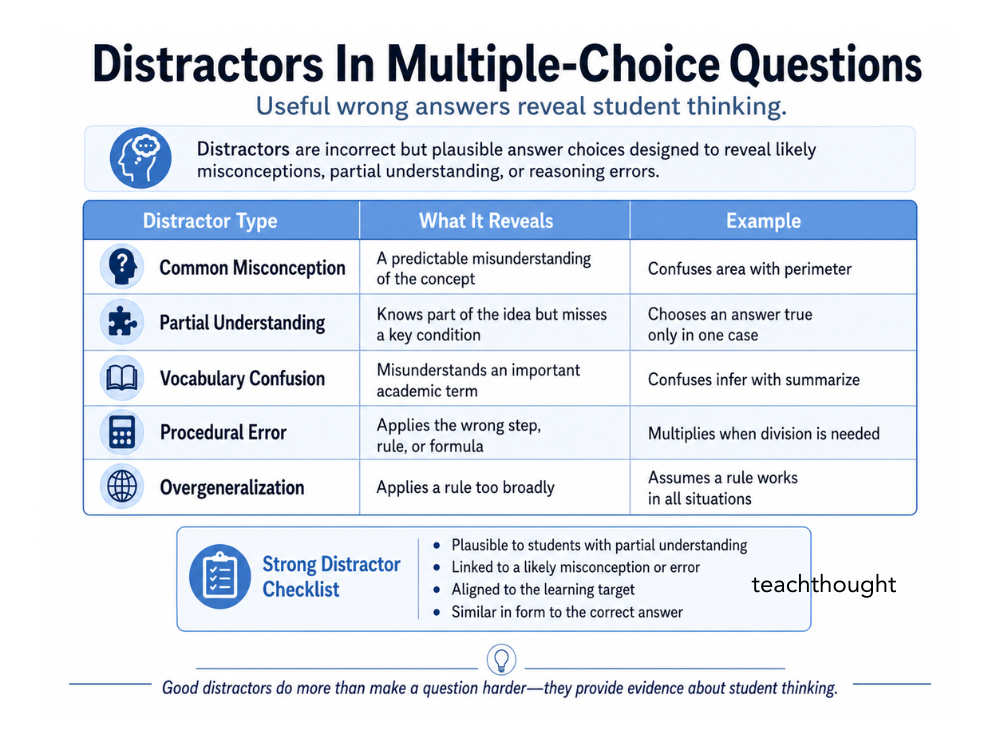
| 5 | Use plausible distractors | Reveal misconceptions and partial understanding. |
| 6 | Keep answer choices parallel | Prevent accidental clues in wording, length, grammar, or structure. |
| 7 | Avoid trick wording | Keep difficulty in the concept, not the phrasing. |
| 8 | Have students explain wrong answers | Turn answer selection into analysis. |
| 9 | Let students revise answer choices | Build precision, metacognition, and assessment awareness. |
| 10 | Use Pass/Revise instead of right/wrong | Emphasize improvement, evidence, and alignment. |
| 11 | Add a confidence rating | Separate secure understanding from guessing. |
| 12 | Analyze response patterns and revise | Use student data to improve instruction and future items. |
Strategy, Benefit, And Example
The following table gives a more practical version of each strategy, including what it improves and how it might look in a classroom.
| Strategy | Benefit | Example |
|---|---|---|
| 1. Start With The Learning Target | Keeps the question aligned to a specific concept, skill, or reasoning move. | Instead of writing a general question about theme, define the target first: Students can identify a theme supported by a character’s decision. |
| 2. Make The Stem Clear Before The Options | Helps students understand the task before reading possible answers. | Weak: Which of the following is true? Stronger: Which sentence best explains why the character refuses help? |
| 3. Have Students Generate An Answer First | Reduces guessing and prevents students from relying only on answer recognition. | Prompt: Before looking at the choices, write the answer you think is best supported. |
| 4. Test Reasoning, Not Just Recognition | Makes the item assess thinking rather than memory of a term or phrase. | Weak: What is an inference? Stronger: Which inference is best supported by the character’s decision? |
| 5. Use Plausible Distractors | Makes wrong answers diagnostically useful by connecting them to likely misconceptions. | A distractor for an inference question might be a prediction, showing that a student may confuse inferring with predicting. |
| 6. Keep Answer Choices Parallel | Prevents students from guessing based on grammar, length, detail, or tone. | Avoid one long, formal answer and three short vague answers. Make all options similar in structure and specificity. |
| 7. Avoid Trick Wording | Makes the question fairer and keeps the challenge focused on the intended learning. | Weak: Which answer is not the least inaccurate? Stronger: Which answer is best supported by the evidence? |
| 8. Have Students Explain Wrong Answers | Shows whether students understand why the correct answer is best. | Prompt: Choose the best answer. Then explain why each other option is not the best answer. |
| 9. Let Students Revise Answer Choices | Helps students recognize precision, plausibility, and support in answer design. | Prompt: Revise one weak answer choice so it becomes a stronger distractor. |
| 10. Use Pass/Revise Instead Of Right/Wrong | Keeps the focus on improving the response rather than simply judging it. | Pass: The response is clear, supported, and aligned. Revise: The response needs stronger evidence, reasoning, precision, or alignment. |
| 11. Add A Confidence Rating | Helps separate secure understanding from guessing or uncertainty. | Students choose an answer, then mark confidence: High / Medium / Low. |
| 12. Analyze Response Patterns And Revise | Turns results into instructional evidence and improves future questions. | If many students choose the same distractor, reteach the misconception or revise the item if the wording caused confusion. |
Multiple-Choice Question Revision Checklist
Before using a multiple-choice question, review it against the following checks.
| Check | Question To Ask |
|---|---|
| Learning target | What does this item measure? |
| Stem clarity | Can students understand the question before reading the options? |
| Reasoning | Does the item require thinking, not just recognition? |
| Distractors | Does each wrong answer reveal a likely misconception or error? |
| Parallel options | Are answer choices similar in grammar, length, tone, and specificity? |
| Wording | Is the difficulty in the concept rather than the phrasing? |
| Student reasoning | Can students explain why wrong answers are wrong? |
| Revision | Could students improve the choices or write better distractors? |
| Confidence | Do students know whether they are sure, unsure, or guessing? |
| Response data | What does the pattern of answers reveal? |
| Item quality | Should the question be kept, revised, or removed? |
| Instructional use | What should the teacher do next based on the results? |
Common Problems And Better Moves
| Common Problem | Why It Weakens The Item | Better Move |
|---|---|---|
| “Which of the following is true?” | Too vague | Ask a specific question in the stem. |
| One answer is much longer | May signal the correct answer | Make choices parallel in length and structure. |
| Distractors are silly or unrelated | Reduces the guessing pool without revealing thinking | Use predictable misconceptions or partial understandings. |
| Item tests vocabulary only | May not show understanding | Put the concept in a context where students must apply it. |
| “All of the above” | Often encourages test-taking strategy | Ask for the best explanation, strongest evidence, or most accurate application. |
| More than one answer could work | Creates ambiguity | Revise until one answer is clearly best supported. |
| No review after use | Wastes useful assessment data | Analyze response patterns and revise the item. |
The Main Idea
Multiple-choice questions are not automatically shallow. They become shallow when the stem is vague, the answer choices are uneven, and the distractors do not reveal anything about student thinking.
When designed carefully, a multiple-choice question can help teachers see not only whether students answered correctly, but why they may have answered incorrectly.
Sources: Haladyna, T. M., Downing, S. M., & Rodriguez, M. C. (2002). A review of multiple-choice item-writing guidelines for classroom assessment. Applied Measurement in Education, 15(3), 309–333. https://doi.org/10.1207/S15324818AME1503_5 · Rodriguez, M. C. (2005). Three options are optimal for multiple-choice items: A meta-analysis of 80 years of research. Educational Measurement: Issues and Practice, 24(2), 3–13. https://doi.org/10.1111/j.1745-3992.2005.00006.x · Brookhart, S. M. (2010). How to Assess Higher-Order Thinking Skills in Your Classroom. ASCD.